Angeles Crest 100

August 3, 2019

I’m not sure when my obsession with Angeles Crest 100 started, but I was enamored by its long history, folklore-epitomized difficulty, and mystique of being in the San Gabriel Mountains. AC100 is a 100-mile (161 km) race with an elevation gain of 21,810 ft (6,648 m) and loss of 26,480 ft (8,071 m). Between training camp in May and a weekend in June, I had seen the course in its entirety. I knew that the course would be tough, challenging my inexperience with heat, altitude, and technical downhills. The hardest section would come in the last 25 miles.

AC100: Wrightwood to Altadena in the San Gabriel Mountains
I spent the week before the race in Boston at an American Heart Association conference. This was not ideal because the days were long, and I didn’t get a chance to take care of my body. I tried to get as much sleep as possible, but I really didn’t have any time to run, stretch, or strength-train.

My return back from the conference was very stressful. The Uber I had called cancelled on me. Then, the second Uber kept circling around SFO because there was construction at the airport, and he kept getting lost. By the time I got home, I had 1 hour to pack for my race before my sister, Amanda, and I headed to SoCal. I haphazardly threw a bunch of things into the car and crossed my fingers that I had everything I needed.

We drove most of the way that night and stayed in a hotel about an hour away from the start line. The next morning, I wanted to sleep in a bit longer, but we had to get to the start line to submit my drop bags in time. I was getting excited about the race. I checked in, got my bib number, and caught up with friends I made at training camp.

Bib pick-up in Wrightwood
PC: Ivan Buzik
I spent the rest of the day writing final notes to my crew, getting ice, and cutting up fruit that I could eat during the race. While putting things in my hydration pack, I realized I forgot to pack extra salt caps. Oh well, I will have to make sure I get them at the aid stations.

The night before the race, I slept intermittently about 4 hours. I thought that the exhaustion from the conference and the stressful trip back would put me into a powerful slumber. Instead I was nervous about the day to come and kept thinking about things I forgot to tell my crew who was flying into LAX that night.
Graham, Amanda, Annalisa, and Cameron at our cabin in Wrightwood
PC: Honoka Eguchi
At 4 am, my sister took me to the start line, we checked in, and waited for the 5 am start. I was just glad that I was toeing the start line without being sick. I ran my last 100-miler with a cold, and I shuddered remembering how I couldn’t breathe or eat during the race.

Starting the race at 5 am in Wrightwood
PC: Honoka Eguchi
Co-race director Gary Hillard started the count-down, and we were off at 5 am. I had a time goal of 27 hours, and my intent was to hike the climbs, especially in the first 25 miles, and run the flats and the descents. I needed to make sure I conserved and felt relaxed until I got to Red Box (mile 60).

Even though the climbs felt calm and relaxed, I was struggling with the running part. My lungs were burning at an altitude of 7,500 ft (2,286 m), and I was not even pushing the pace. I checked into the first aid station 9 miles in, realizing that my time goal of 27 hours was slipping through my fingers.

View from Mt. Baden Powell
The next push was a 3.6 mile to the highest point in the race, Mt. Baden-Powell at 9,300 ft (2,835 m). Again, the climb felt solid but I could feel the thin air getting to me. I knew I had to run the downs at a good pace to make up for hiking the long climbs. As I descended from the highest point in the race, I tripped over a rock. Thankfully, I didn’t fall but I could feel my calf being on the verge of a cramp because I was lacking salt. I forgot to pick up salt caps at the last two aids stations.

A significant portion of the first quarter is on the Pacific Crest Trail
As I continued on the technical downhill, I began to feel light-headed and the lack of oxygen was remarkably apparent. I’m not sure whether I lost consciousness for a split second or simply could not stay focused on the trail, but I tripped over another rock, flew over the single-track, and found myself landing like an X, face-down on the landslide below, clutching the dirt with my hands and teeth so I wouldn’t continue sliding down to the valley below. I tried to push myself up, but both of my calves and my right hamstrings were cramped. At this point in the race (mile 18), the crowds had not thinned out, and the next three runners flipped me over and pulled me up onto the trail.

“Can you get up?”

“My calves and hamstrings are cramped. I can’t get up.”

“Are you lacking salt?”

“Yes.”
Clear skies in the San Gabes
Once I was off the landslide, I regained control of my muscles. One guy gave me a muscle relaxant for the cramping, and another guy gave me two salt caps. Meanwhile, the conga line kept moving behind me with the occasional runner asking if I was ok, and me responding, “Yes, keep going.”

I stood up, and the three men who lifted me from the landslide urged me to slow down. I spent the next few minutes assessing the damage, spitting the dirt out of my mouth, and processing what had just happened. Ok, good. Just superficial abrasions on my left knee, stomach, and my thighs.

Adrenaline was rushing through my veins, but I was tired. Just get to the next aid station and things will turn around.
Coming down Islip Saddle with my torn shirt
PC: Ivan Buzik
I ran into Islip Saddle (mile 26) on a mission. “I need salt!” I told the volunteers. I bummed as many salt caps as I could from this aid station.

In my rush to get in and out of the aid station, I ran past Annalisa and Amanda. I backtracked to the sounds of their voices yelling my name.

“I had a really bad fall.” I showed them the scars on my belly and my knee.

“I’m really struggling with the altitude, and I ran out of salt,” I started crying in frustration.

“Just breathe, and don’t think about the past, just think about this point going forward,” my pacer, Kevin, said.
Putting sunscreen on my dirt-covered face
PC: Amanda Mullins
I was covered head to toe in dirt, and I was so happy to clean up with a wet towel. I ate my smoothie and fruit, put on sunscreen, and got loaded with ice. As I took off, I looked at my watch. Ok, now I’m 45 minutes behind schedule. Let’s shoot for a 28-hour finish.

I made it to the next two aid without any hiccups. Friends from training camp, Felix and Cody, were keeping me in good spirits along the way. I gave Pikachu a high-five before getting to Cloudburst Summit (mile 33).
Heading to Eagle's Roost (mile 28)
PC: Honoka Eguchi
The heat was starting to take a toll on me, and I knew I was pushing the pace on the ~10 mile road section. At Cloudburst, I met Annalisa, Amanda, and Kevin. I put on my trail shoes here and loaded up with more ice. I knew I was spending too much time at the aid stations, but after the fall at mile 18, I was keenly aware that I needed to take extra time to take care of myself.

Getting ice from Annalisa
PC: Amanda Mullins
On my way to Three Points (mile 38), I heard a lady singing at the top of her lungs, “Can you feel the love tonight?” It was Frannie from training camp coming up behind me in all her glory. Then going through the yellow gate at Glenwood, I saw another friend, Heidi. Approaching Chilao, I ran into Kevin from my training weekend in June. It was fun knowing that I was sharing the miles with friends.

Mt. Hillyer (mile 41) to Chilao (mile 45) was a really tough section with blazing heat over large boulders and many off-shoots disguised as trail. I couldn’t wait to pick up my pacer, Cameron, at Chilao. While I ate my fruits and smoothie at this aid station, Graham made sure I got loaded with ice.

Climbing into Shortcut Saddle
PC: Graham Erwin
The section to Shortcut Saddle (mile 51) was technical at times, but I made it to this aid station with the new 28-hour finish goal still within grasp. Now, my quads were beginning to feel spent, and I realized that I was starting to crash. It was beginning to get really hard to run downhill, and Cameron was starting to get bored with my slowness. I asked him to run ahead of me so that he wouldn’t run into me during my frequent stop-and-go spurts. The sunset was really beautiful as we descended into West Fork.
Sunset from Red Box
PC: Graham Erwin
At Red Box (mile 60), I knew that I had a long night ahead of me, but I was determined to get to the finish line. My quads were shot, and I could barely run. I asked Graham to relay the message to the rest of the crew that I was going to get to Chantry Flat (mile 75) much later than anticipated. I wanted to scrap our original plan and have the crew wait at home, but I felt like we were not communicating. It had been a long day for Graham, and it was reasonable that my suggestions were not clear.

Crawling into Red Box (mile 60)
PC: Graham Erwin
Anna from training camp got me chicken noodle soup and cleaned my wounds from my fall at mile 18. I felt defeated and was regretting my pace earlier in the day that put me in this condition. Cameron offered to continue with me to Chantry, but I needed to get in the right headspace to chase cutoffs the remainder of the race.

I left Red Box with a burning desire to finish, but it started to sink it that I only had 16 hours left to cover 41 miles. Even though my quads were shot, I knew I had to run as much as possible to keep my average pace low. Mallory from training camp told me at the spaghetti dinner the night before that he would be close to the cutoffs on race day. I didn’t register what he was saying at the time, but now I was admiring his tenacity to get on the start line, fully aware of the close calls to come – this feeling that suddenly hit me like a ton of bricks. Do I have what it takes to chase cutoffs?

At mile 62, I threw up everything I had eaten at the previous aid station and more. The nausea hit me most unexpectedly. I kept sipping on my energy drink but every sip made me feel even more nauseous. Maybe I need more salt.

I took two salt caps and washed it down with plain water. At mile 67, I threw up violently again. The nausea was physically draining, and I was in survival mode just trying to get to the next aid station.

At Newcomb (mile 69), I saw a medic who had a melodious voice and calmed my nerves. I told her that I threw up twice, and I can’t seem to get rid of the nausea. I was also concerned about hyponatremia. First, she suggested that I sit, and let my stomach settle a little bit. My oxygen level was 95%. “That’s a bit low, but you’re fine!” she said cheerfully. “You’ve just over-exerted yourself, and that’s why you’re throwing up. Sixty miles is a long way to go!”

Then, she had me eat potatoes slowly and drink some soda. “What happens if I drop here?”

“You don’t want to drop here,” the medic said. Newcomb was a wilderness aid station with no crew access. “If you drop here, you’ll have to wait with me until morning when we close the aid station. You’re fine! Just take a nice stroll to Chantry. It’s all downhill and a short climb into the aid station.”

Five minutes after I had taken my last bite, the medic gave me permission to go. I was at this aid station for 47 minutes. My race was over. I just needed to get to Chantry (mile 75), where I would meet Amanda, Annalisa, and Kevin. I’d get to go home.

The next 6.6 miles was not as pleasant as the medic had made it sound. The beginning of the six-mile descent was steep and technical. I was cursing the medic at Newcomb, but as I traversed the descent, I could see Los Angeles and all the beautiful city lights twinkling below.

LA twinkling in the valley below
I felt like someone recovering from food poisoning – tired, dehydrated, and strained with acid in the esophagus. Even though I was going at a snail’s pace, I was content. I’d be at Chantry eventually, and the suffering would be over. What did this mean for my future racing? Would I be terrified of the AC100 course forever? I admired all the people who passed me and were still running. Go catch that cutoff!

As I made short 0.6 mile climb up Chantry, I knew it would all be over soon. My sister would drive me home on Sunday, and I’d get to sleep in my own bed. I felt comforted by the warm and fuzzies.

“Asuka, is that you?” Kevin asked as I approached the top of the hill.

“Yeah. Sorry it took me forever to get here.”

“It’s ok, we still have time to get you out of the aid station.”

I burst into tears. “I’m not going back out there. I can’t even drink a sip of water without throwing up. There’s no way I can finish this race without fueling.”

Annalisa and Amanda nervously restocked my hydration pack as I argued with Kevin.

“You need to get out there and give it your all. If you don’t put it all out there on the course, you’re going to regret it. You’re going to see that second sunrise, and it’s going to lift your spirits,” Kevin said reassuringly.

“Do you want to change your socks?” Amanda asked.

“I’M NOT GOING BACK OUT THERE!” I screamed in disbelief.

Before the race, I had told my crew and pacers not to let me quit unless I had an injury that was going to have lasting damage to my health or I was throwing up for five consecutive hours. They were now holding me up to these conditions.

“Let’s just go up one mile, and if you are still feeling terrible, you can just walk back down to this aid station,” Kevin said.

“Here’s some soup. Do you want to change your socks?” Annalisa asked.

I drank the soup and changed my socks. In my terrible state of mind, I read the distance to the next aid station wrong. I calculated that there was enough time to meet the next cutoff as long as I went at a 30 min/mi pace. Kevin quickly nodded in agreement without correcting me.

We left Chantry four minutes before the cutoff. I was going to prove to Kevin that he was wrong. My body had shut down, and even if I could make it to the next aid station in time, there was no way that I would be able to keep my average pace below 20 min/mi to finish the race. I had 26 miles left with 6,050 feet of gain and 6,900 feet of loss. I only had 8 hours and 40 min left to cross the finish line. I knew a good deal of the descents would be technical, and the thought of going down those hills scared me.
Elevation profile of Angeles Crest 100
As we climbed, I continued to cry about the terrible decision to leave the last aid station to drop. The next three aid stations would be in the wilderness. “I just need to accept the fact I didn’t train enough. I went out to hard at the beginning, I trashed my quads, and…”

Kevin cut me off, “No, no, no, no, no. You trained enough. You’re going to make it.”

You don’t even know me. How do you know I trained enough?

About 45 minutes after we left Chantry, the sun began to rise. My body started accepting food and water again. I guess circadian rhythms do regulate the digestive system after all.

“Keep your breathing relaxed, and just stay focused on taking care of yourself. Once we get to the top of the hill, you’ll have a long downhill,” Kevin said encouragingly.

I burst into tears again. “I can still climb. It’s the downhills that I can’t do anymore.”

Every step of the descent was painful on my quads and knees, but I knew I had to move if I wanted to make it to the finish line. I whimpered incessantly and cursed whenever I tripped over a rock.

“Just continue to stay relaxed, eat, and drink. Don’t worry about your pace. I’m sure that once we get close to the finish line, you’ll be able to run some 10-min miles,” Kevin said.

What? That’s your plan? I can’t run anymore – can’t you see that?!

I couldn’t believe that I was continuing on in this condition, but I just tried to turn my brain off. Just make it to the next aid station.

The climb to Sam Merrill (mile 90) was hot and punishing. I was able to drink some soda here and got some relief from the heat with ice. One of the volunteers told Kevin that he met the cutoff at a different race by running for 2 days and 3 hours. Wow – how inspiring.

As we got closer to Millard Canyon (mile 96), my body was overheating. The heat made my muscles feel less stiff, though, so I could push the pace a bit more. We had 5 miles left and a little over 1.25 hours before the absolute cutoff. Now that I could smell the finish line, the adrenaline was suppressing the pain, and I had my running legs back.

“I really need to cool down,” I announced as I got to this aid station. “I just need 5 minutes.”

“YOU DON’T HAVE FIVE MINUTES!” a volunteer at the aid station shouted. “Do you want a popsicle?”

As I grabbed the popsicle from her, I insisted, “I can run now. I’m just overheated, and I really need to cool down. Just give me five minutes. I can run. Right, Kevin?”

He nodded nervously.

After my pack, bottle, and buff were filled with ice, another volunteer goaded me on. “Ok, it’s time to go!”

I looked at my watch, and it had only been 3 minutes. “I just need one more minute.”

“30 seconds!” the volunteer responded.

Really? You’re going to cheat me out of 30 seconds right now?

As I took off from this aid station, I noticed that my pack wasn’t jangling with ice. Those volunteers forgot to put ice in my pack! I took a sip of water and noticed it was cold. Oh no, the ice already melted.

The heat radiating from the walls of Millard Canyon was absolutely brutal. I touched my shirt and noticed that all the ice I had put in my sports bra had melted, too. Not even a minute had passed since we left the aid station. I could feel the heat emanating from the dirt trail through the soles of my shoes. Even though I was certain that I could finish when I left the aid station, the heat quickly killed my confidence.

Getting to the home stretch in Loma Alta Park
PC: Honoka Eguchi
The last four miles of trail before entering civilization was long and more technical than I remembered. It wasn’t until I exited the trails and hit the asphalt with one more mile to go that I felt sure I could complete the race. By the time I arrived, many of my training camp friends were already at the finish line for the awards ceremony. I crossed the finish line with 16 minutes to spare. Only two more people finished before the absolute cutoff.

Getting to the finish line 16 minutes before the cutoff
PC: Ivan Buzik
I could not have done this crazy race without my crew, Honoka, Annalisa, Amanda, and Graham as well as my pacers, Cameron and Kevin. Through all the whimpering, crying, and complaining of the heat, Kevin maintained his patience and kept me focused on staying relaxed and not falling on my face. I will never know why he believed in me even after I was fully convinced that my body had shut down at Chantry.
My training camp friends at the finish line
PC: Honoka Eguchi
At the awards ceremony, they presented plaques and buckles backwards from dead last finisher to first place. As I approached the race directors when they called my name, someone blurted out, “Isn’t that the girl who UltraSignup predicted would win the race?” Damn straight, and I almost finished last, but I finished, even after I thought the race was over at mile 75, and the finish was so much sweeter for it.
AC100 finisher's plaque
PC: Honoka Eguchi
Time 32:43:28
Overall Place 153/155
Gender Place 24/25

Rio Del Lago

November 3, 2018

Seven days before Rio Del Lago, I noticed I had an itchy throat. Hopefully, it’s just allergies, I thought, and took a Zyrtec. The scratchy throat did not go away, and I was certain I had caught the dreaded cold a week before the big race. At first, the symptoms were mild, but then 3 days in, my cold symptoms began to get worse with muscle fatigue and all. of. the. mucous. It gets worse before it gets better, right?

When I lined up at the start line, I was very stuffy and had an incessant cough, but the muscle fatigue was gone. Just be grateful that you’re not a weakling, I told myself. Sure, I can’t breathe, but once I start running, maybe my sinuses will clear up. After a short race briefing, the countdown to the 5 am start was on, and off we went.

Right before tripping at mile 20
The first 10 miles are all paved bike path and gravel. I planned on sticking to a 10 min/mi pace, which felt agonizing slow on fresh legs. As I saw about one hundred runners zoom past me, I was very jealous of how much fun they were having. I want to run and have fun, too! But with my lingering cold symptoms and my lack of experience in running a race this long, I knew I had to hold myself back. Because talking put me into a coughing frenzy, I couldn’t even chat with the other runners. As I slowly trotted along, I gnawed on the ham and avocado sandwich I packed for the morning.

As we looped around Lake Natoma, we started to hit the trails, running along the bluffs overlooking the lake. It was still dark at this point, and I had be careful over the uneven footing on the trail. I tried to maintain a similar effort for this section, so slowed my pace. Around mile 13, the sun began to rise, and it was nice to be able to see the scenery around us. My cough got annoyingly persistent, so I started taking some cough drops. I couldn’t wait to see my sister, Honoka, at mile 18, the first aid station. I was starting to get bored, and it was nice to have something to look forward to. I had no idea what the aid station would look like and how difficult it would be to find her, but she spotted me right away. I stocked up on fluids and gels, and off I went.

At mile 20, in my typical clumsy fashion, I tripped over a small rock. I slowly baseball dived into the trail, grazing my forearm, knee, and thigh. Embarrassed that I tripped over smooth trail, I quickly got up and kept moving forward. I have no idea if anyone saw me fall. I don’t think I’m even bleeding. I slid into the ground ever so slowly. I glanced at my palm and my arm right above the elbow. I’m bleeding.

I knew an aid station was coming up at mile 23 and my friend, Marty, would be waiting for me there. I saw a bathroom preceding the aid station and rushed to the sink to remove all the dirt out of my freshly grazed skin. I did a quick assessment, and saw that I needed to clean three spots. I tried to raise my knee into the sink, but I was too short to push my knee closer to the faucet. In haste, I threw a bunch of water onto my knee, then exited the bathroom in a hurry. Another lady was trying to get in as I was going out. I apologized. I made a mess in the sink.

As I approached the aid station, Marty called out my name. I told him that I was bleeding in just a few spots because I fell. He wiped the dirt out of my wounds and put some antibiotic ointment over the spots. Just a week before, when Marty offered to come to this aid station, I thought it was absolutely nuts for him to drive from the Peninsula to Granite Bay just to see me for five minutes or less. Now I was so grateful that he was there to clean up my wounds.

Granite Bay (mile 23)
Feeling energized by all the support, I headed toward the next aid station, Rattlesnake (mile 35). Along the way, I met Jennifer, a local who participates in RDL every year. Usually, she volunteers or paces, but this year, she was running it. She gave me a lot of advice about running my first hundred, and it was nice to be taking in some last minute tips. While we were talking, the runner in front of us asked if we veered off course. Uncertain, the three of us started back-tracking, and we found the course markings where we missed a turn. We had not strayed but a tenth of a mile.

Once we were on the right track, I suddenly found myself in a conga line on the single-track trail. At first, we were moving at a reasonable pace, but as the miles tacked on, I felt like the 15-person conga line was moving slower and slower. I was getting frustrated but was afraid to pass the leaders of the line. One girl lost her patience and was zooming past the conga line, almost falling when she reached the front of the line. Even though I wanted to do the same, I convinced myself that I was not well, and there’s a huge chance that I will blow up late in the race. And when I blow up, all these people in the conga line will laugh at me.

With pacer Cameron
At Horseshoe Bar aid station (mile 32), I just picked up some ice then split off from the pack of runners. At last, I was free! I could run my own pace and have fun running! I felt like I was patient long enough, and I could let myself run as my heart desired. But don’t go out like caged animal. The next aid station where I’d see my friends, Graham and Cameron, was just three miles away. When I arrived, I heard my name and found my crew had laid out everything in my drop bag in plain sight so I could pick up what I needed. It was starting to get really warm, so I made sure to carry ice in my buff and my bra to keep my core cool. “What place am I in?” I asked. They weren’t sure, so I asked them to check and tell me at Overlook. They quickly restocked my pack, and I was on my way along the American River.

Coming up to Overlook (mile 44) with Nate
I was really looking forward to getting to Overlook (mile 44), where I would pick up a pacer. I knew Cardiac Hill into this aid station would be a long three mile climb, but this section went by very quickly because another runner, Nate, kept me company. He was raised in Wisconsin and lived in Minnesota, so it was fun to chat about all things Midwest. I could tell he really looked up to his grandfather and the research he had done.

So happy to see crew
Graham, Cameron, Honoka, and my pacer, Bill, greeted me at Overlook. I was elated to see them and sat down to put on some fresh socks. “You’re in fifth place,” they told me. As I reached over to put my shoes back on, my abs cramped. That’s uncomfortable. The cramp lasted no more than a few seconds, and it was a reminder that I should take some salt. I tried to eat off the table since I knew I would get sick of gels later in the evening. The oranges looked good. I should pack more fruit next time.

I was happy to be back on the trail again, and while there would be a long ways to go, I thought it would be easier with pacers. My first pacer was Bill, who I met at the Avalon 50 in January. He was super chatty and made the miles go by very quickly. Once we crossed No Hands Bridge (mile 48), the race started to thin out. The heat was really getting to me, and I started to get sick of drinking the Roctane drink mix. I was trying to get half my calories from fluids and half my calories from gels, but I could feel the nausea starting to creep in.

Cameron, Honoka, me, Bill, and Graham
As we made our way to Auburn Lake Trails (mile 59), I kept brushing my forearm that was bleeding earlier in the day against the branches that poked into the path. Every once in a while, I would shout out in pain, and I hope I didn’t startle my pacer too much. At one point, I was startled by some loud rustling in the woods, and Bill noticed me staring into the forest. “All the sounds you hear today are from squirrels and cute bunnies,” he assured.

A blister on my pinky toe and a bruise on the top of my foot started to take a toll on me. We stopped on the side of the trail in an attempt to address the foot problems. Wrapping the blister only intensified the pressure, though, and I immediately had to take pad off my blister. On the plus side, sitting for a brief moment did magic to my quads. It was like I had new legs and could run again without taking frequent walk breaks. What a great discovery! It helped me power hike through Goat Hill, a short but steep section of the course.

Around mile 64, the sun began to set, and the sky turned a glorious hue of deep oranges and reds. The sky was on fire.


A while after it got dark, we caught up with Brady who was running sans headlamp. I was impressed with how he got through all the uneven footing without a light. We stuck together to No Hands Bridge (mile 70) so he could see the trail better between our headlamps. It seemed to take forever to get to the Highway 49 aid station (mile 67), but then the excitement of getting to No Hands and closing the hilly lollipop of the course made the time go by more quickly.

At No Hands, I picked up Cameron, my second pacer. I was surprised to see Calvin, my third pacer at this aid station, too. “You’re in fourth place,” they told me. I got to this aid station about 40 minutes later than I projected because I didn’t account for all the breaks I would take at the aid stations without crew. As a road runner, I never stop but a few seconds at aid stations, but of course I needed to take longer 10-minute breaks for a race this long! We took the Western States trail up to Overlook. There was more climbing than descending in this section. Only 30 more miles to go. Wait 30 more miles? I don’t even want to run a marathon let alone 30 miles. Don’t think about that. Just get to the next aid station four miles away. I was eager to see Annalisa and Marilyn there. Also, it was thrilling to know that I had surpassed a personal distance record.

Restocking at Overlook (mile 74)
At Overlook (mile 74), I was surprised to meet my entire crew. I was relieved to get into new shoes that were a half size larger than the ones I was wearing. I should have put on these shoes at mile 44. At Overlook earlier in the day, Graham and Cameron got on to me about not eating enough over the 9-mile section from mile 35 to 44. I had only eaten one gel and 3 cough drops. Now I found myself asking my crew if I could get enough calories from the cough drops because the gels and drink mix were really not settling well in my stomach. “The cough drops are maybe 10 calories,” Annalisa said. I hope the broth and orange slices will carry me through the night.

I was overwhelmed with the love and support I had at Overlook aid station. To see my gang of seven supporting me in the race inspired me to keep my eye on the finish line. There is a three mile descent on road and gravel out of this aid station. I was clinging onto this sliver of hope of being able to run this section, and I was ecstatic to find out that my legs could still turn over with good cadence. As we cruised down this hill, we passed the #3 female, who was walking down this section to Cardiac aid station (mile 78). I’m so glad I still have my running legs.

At Cardiac, I sat in a chair and tried to consume more calories. I can only eat broth and orange slices. This is going to get ugly. I told Cameron that I was eating a Jolly Rancher, twice the size of a cough drop. That’s double the number of calories. “There’s a girl who just left this aid station. Go get her!” said one of the volunteers. I assumed they were telling me that I was leap-frogging with the girl who was walking down the hill into the aid station. She seems to be fading, and I still have some running left in me. I can get back in third place. That seems reasonable.

Once we got back on the trail, Cameron clarified my confusion. “You’re already in third place, Asuka.” They were telling you that #2 left the aid station, and you can catch her. Well, I don’t know about that.

A couple miles later, we came upon two headlights moving along the trail. Is that the #2 female? She was walking along a flat smooth section with her pacer, so I was able to maneuver past her. She asked Cameron, “Is she the runner?” I imagined that she had been holding on to the #2 position for most of the race, and it must have been painful to hear Cameron respond, “Yeah, she’s the runner.”

The trek to Rattlesnake aid station (mile 83) seemed to last forever. I was leap-frogging with two other runners and at one point, we weren’t sure if we had missed the aid station. I checked the map off my phone, and we were less than half a mile away. When we got to Rattlesnake, the aid station seemed quiet and empty. I scoped out the parking lot and didn’t see my sister or pacer, Calvin. Where is my crew and pacer? I had my essentials in my drop bag, and I had some broth and orange slices from the table. In my hydration pack, I carried a hard copy of my projected times at the aid stations. The spreadsheet said Rattlesnake at 11:30 pm, and it was 11:32 pm. I hope they didn’t get in a car accident.

Once we were both sufficiently fueled, Cameron and I started discussing the elephant in the room. “Did we get here too early?” Cameron asked.

“I don’t know. I asked them to be here at 11:30 pm, so I don’t think we’re early. I’m not sure what to do,” I replied.

“Well, I’m not going to let you go back out there by yourself.”

“Ok, well, let’s leave them a note on the drop bag, since we don’t have reception here,” I suggested.

Meanwhile, Graham, Marilyn, Honoka, and Calvin were on their way to Rattlesnake. Since I arrived at Overlook 40 minutes past schedule, they decided to leave later for the next aid station. While they were driving, Honoka got a notification from the tracking app that I arrived at Rattlesnake at 11:25 pm. “Did anyone bring the food bag?” Marilyn asked. Realizing they didn’t have crewing supplies, Graham, who was driving, turned the car around back to the hotel. They grabbed the bag, then Graham sped toward the aid station. He ran a red light and drove down the windy road leading to Rattlesnake aid station like he was driving a race car. “Whoa, whoa, whoa. Calm down,” Calvin told the crazy driver.

When Calvin arrived at the aid station, the volunteers immediately asked him if he was looking for the Asian girl who is #2 female. They told him that I had already left. Calvin grabbed my thermos of coffee and sprinted down the trail. Cameron and I had not made it very far, so he caught up with us easily. I was really happy to see him – to know that my crew was ok and that Cameron could be relieved of his pacing duties. “What happened?” I asked Calvin.

“Nothing happened. We were just chatting at the hotel and left a little later because you were behind schedule. Do you want some coffee?”

When I learned that the volunteers told Calvin that I had already left the aid station, I asked him how they knew to tell him that. “How did they know that you were my pacer?”

“I don’t know. You’re Asian, and I’m Asian, so I must be your pacer. That’s all I can think of.”

The volunteers must have been eavesdropping on the conversation Cameron and I were having.

The trail crossed paths with a road that led to the parking lot to Rattlesnake aid station. Here, I parted with Cameron. Calvin and I made our way toward Horseshoe aid station (mile 86). I had some broth, an orange slice, and a third of a banana. I braced myself for the technical section called meat grinder. I knew it was coming up, and the worst of it would be only two miles. I prayed that I would have the mental strength to power through that section. I met Calvin about two months earlier when I joined a group run that he led at Mt Tamalpais. Even though I had only met him once, he graciously agreed to pace me for this race. At this point, I could feel all the aches from my quads, ankles, and feet. Calvin barely knows me. I need to be on my best behavior.


Meat grinder did take forever. All the big rocks and uneven footing intensified the pain in my quads and put pressure on the blister I had on my pinky toe. I don’t know how Calvin had the patience to stick with me the entire time because I was going painfully slow. I was afraid that I would fall or get a cramp if I misplaced my foot, so I was being very careful. The course markings were not obvious at every fork, so Calvin ran up ahead and made sure we stayed on the right path. Around mile 89, I sat on a rock for one minute then stretched out my calves. After taking advantage of the trick I learned earlier in the day, I got my running legs back.

When we got to Granite Bay (mile 96), Calvin dumped out most of the drink mix out of my hydration pack to lighten the load. Whoa, my body feels so light with so little in the pack. Home stretch! I was going to make it.

I was excited to be four miles away from the finish, and the excitement carried me for a couple of miles. Around mile 98, my mental state got worse before it got better. Would I still make it under 24 hours? Calvin asked me what time it was. “It’s 2:20 am,” I said. Since day light savings ended around this time, it made it even more challenging to calculate the finish time.

“If it’s 2:20 now, that means it’s 3:20 on Saturday time, so you’re on track for sub 23-hours,” Calvin calculated. Calvin is doing the math all wrong. I only have 40 minutes to finish 2 miles to make it under 24 hours. No point in correcting him now. He’s been so patient with me already.

When we hit the bike path that leads to the finish line, I could see the finish line arch lit up to my left. According to the official RDL map, we were supposed to go through the campground, not the bike path. “Are you sure, this is the right route?”

“Yes. I’m going to tell the group that you’re coming!” Calvin said and took off running. I didn’t even get a chance to tell him about the official race course map. Oh well. I was super stoked to cross the finish line as second female, still with some running legs left in me. Sub-23 hours. Calvin was right.

With pacer Calvin
I feel super lucky for how the race played out. Even though I was stuffy with the cold, I was able to survive the race without much of a hitch. I got nauseous but didn’t throw up, and I remained reasonably coherent to the end. I didn’t hallucinate or get mauled by a bear. Life is good.

I could not have done it without my pacers Bill, Cameron, and Calvin. I am so grateful to my crew, Honoka, Marty, Graham, Annalisa, and Marilyn, who gave me the strength to stay focused to the very end. Knowing that they sacrificed their entire weekend to support me was truly inspirational.


Time 22:41:41
Overall Place 39/251
Gender Place 2/80

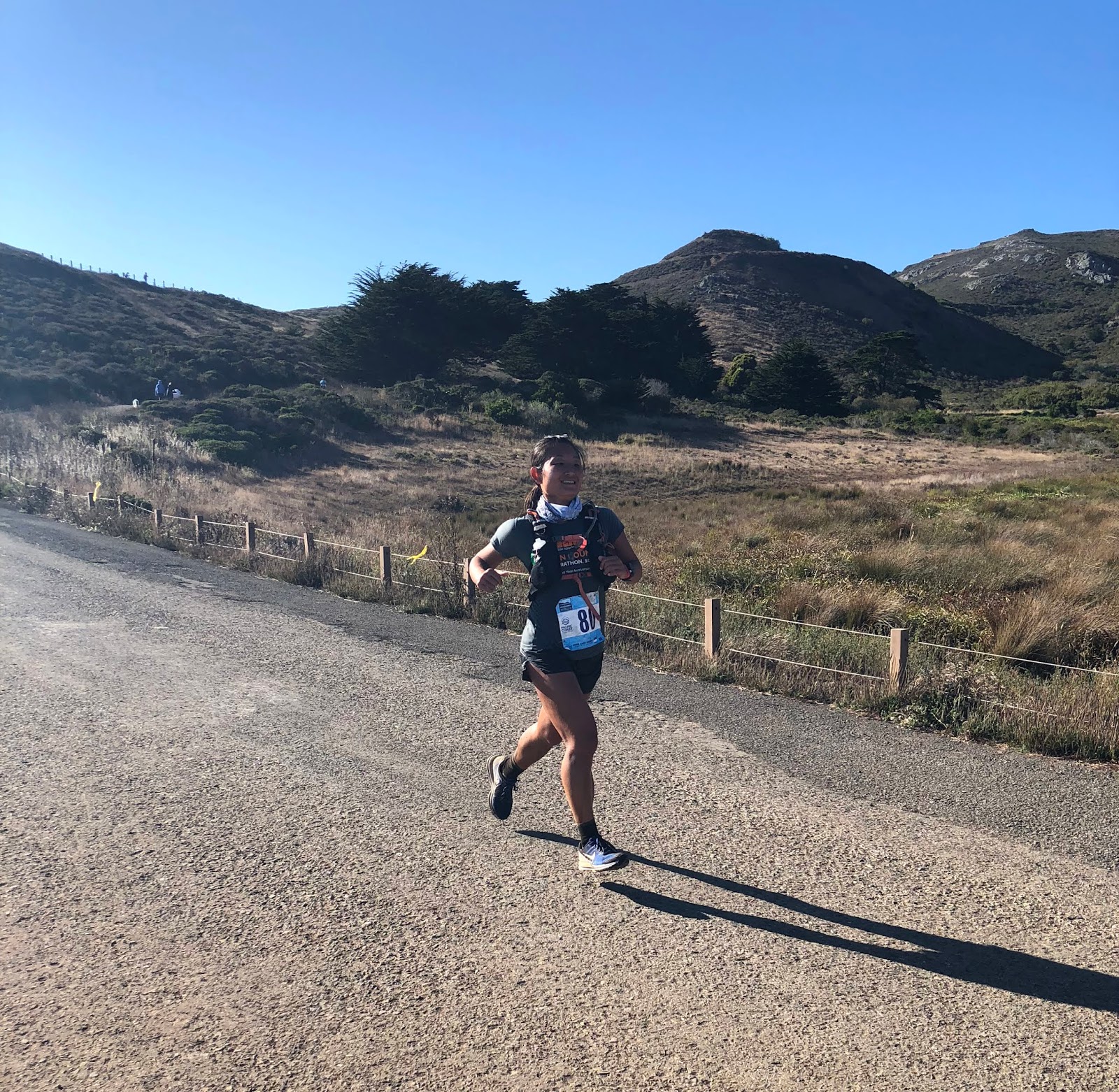
Headlands Hundred: 50 Miler

September 8, 2018

Leading into the Headlands 50-Miler, I was not feeling very confident. In early August, I started nursing some niggles (shin splints on my right and plantar fasciitis on my left foot). The soreness did not prevent me from running, but as soon as I felt them, I knew I had to cut back on training if I did not want them to turn into full blown injuries. So rather than ramping up 3-4 weeks before the race, I was cutting back in both intensity and volume. In addition to cutting back, I was icing, rolling, wearing orthotics in the shoes I wear at work, and wearing a boot to keep my calf stretched during the night. All of these tricks ended up paying off, and I was able to show up to the start line injury free.

The Headlands event is a series of 25-mile loops, run clockwise, then counter-clockwise. I had gone up to the Marin Headlands four times in training, each time completing one 25-mile loop. Being familiar with the course, I had three goals in mind for the Headlands event:
  1. Run the middle 30 miles hard because the first and last 10 miles are less runnable.
  2. Do not trip and fall on my face.
  3. Eat consistently, and try not to get nauseous.
The days leading up to the race, I was working long hours and was very sleep deprived. This was a recipe for disaster, but I had started some long-term experiments that I could not forgo. To make things worse, I made cheesecake two nights before the race, adding to my sleep deficit. Not thinking things through, I had promised friends who were coming to the finish line that I would celebrate my birthday with home-made cheesecake. The night before the big day, I was frantically packing all the things I would need for the race and the party at the finish line. After I went to bed, I kept remembering things that I forgot to pack, so I got out of bed repeatedly and tried to fall back asleep again.

When the alarm went off in the morning, I felt surprisingly refreshed and excited. I did not get enough sleep, but I felt ready to conquer this race. I had a game plan. My little sister offered to drive me to the start line and cheer me on at the midpoint of the race. It was very kind of her, and it was fun to share my excitement about the race during the 50 min drive. For my sister, it was an early morning, and she was also sleep deprived, so she booked a bed at the hostel at the Marin Headlands. The receptionist was a bit confused when she explained that she wanted book her stay for just the day and not the night. “You just want to sleep all day??”

The legendary Eldrith Gosney, who finished her
seventh 50-miler. She has also done three
100-milers at the Headlands Hundred.
It was pitch black when we got to the start line. I got my race number, then took off my layers. I was surprised that I wasn’t cold in my shirt and shorts. In all my training, I was shivering at Rodeo Beach with the strong winds and dense fog. Maybe it was going to be an unusually warm day.

Race Director, Greg Lanctot, made his announcements for the race and made sure we all knew the order of the ribbon colors that marked the trail. After he made his announcements, he told everyone that it was my birthday the previous day and gave me an Ultimate Direction hydration vest as a gift. When he called my name, I had just smeared sunscreen all over my face, so I was trying to rub all the white cream off my face and onto my arms in haste as I approached Greg. One person started singing “Happy Birthday” and before I knew it, all the runners were singing in unison as they watched me slap sunscreen from my face to my arms like a maniac.

I always find all the energy right before a race so invigorating. As I made my way to the start line, I noticed the legendary Eldrith Gosney wearing the #1 bib. She is a local celebrity going strong at the age of 77. She was toeing the line for her seventh Headlands 50-miler. She has also completed three Headlands 100-milers, the last one when she was 70 years old. I was really excited to spot her and asked for her picture. A bystander commented, “See, you’re famous.” Eldrith looked abashed and brushed off the comment.

A rare blue clear day at the Marin Headlands

Greg did the count-down to the race start, and we were off. Since there were four different events going on (marathon, 50-miler, 75-miler, and 100-miler), I was careful to pay attention to the color of the bracelet each runner was wearing. The people running 50-miles were wearing a red bracelet, and I was on the look-out for that color to identify my competition. Early in the race, I saw one woman wearing a red bracelet take off. I tried to keep her within sight, so I picked up the pace. By mile 2, she was well out of sight, and I kind of settled into a pace that seemed more reasonable. Then at mile 3.5, another woman with a red bracelet passed me, and again I picked up the pace to keep up with her. It was dangerously early in the race to be chasing the leaders, but I convinced myself that if I wanted to win the race, this was a risk I had to take.

At mile 4, we hit our first aid station in Tennessee Valley. Not needing anything at the aid station, I kept going, settling into a pace that seemed hard but sustainable. I expected the woman who had just passed me, but then stopped at the aid station, to catch up with me at any moment. As I ran along Coastal Ridge into Muir Beach, I felt the sun beating down on me. It was going to be long day in the exposed trails. Zero fog. No wind.

SCA Trail overlooking Golden Gate Bridge

By the time I hit the mile 12 aid station, I felt drained from the heat. I told the aid station volunteers that the unexpected hot temperatures were really getting to me. The volunteers gave me ice, and I continued my way toward the aid station under Golden Gate Bridge (mile 18). At one of the switchbacks, I saw that the third female was tailing me. The volunteers told me I was five minutes behind first female. Before the race, I was really looking forward to running up the paved road from under the bridge back to the trail, but something was off. I suddenly felt exhausted from going out too fast in hot weather. I really needed to back off the pace.

As I made my way up the SCA trail, the third female caught up to me and ran past. I intended to run this section, but I needed to take some walking breaks to manage my core temperature. I was not going to be able to follow through with my plan of running the middle 30 miles hard. As I ran down Bobcat Trail, I noticed a woman in a light blue shirt walking down the hill. She was wearing something similar to the lead female, but I told myself that she was running too strong to be walking down the hill at mile 22. I was eager to get to the finish line and close loop 1. I knew my sister and friends, Amanda and Marilyn, would be there to send me back out.

When I arrived at the finish line, the girl who passed me near the Golden Gate Bridge was on her way back out. I found my sister and Amanda near the drop bag, and I whined to them as I restocked on fluids and gels. “I didn’t expect it to get so hot. I’m feeling waaay too tired for it to just be half-way in the race.” They looked concerned and didn’t know what to say. As I rushed back out for loop 2, I braced myself for a long afternoon.

              The Headlands 50 has total gain of 10,000 ft and equal loss
Loop 2 goes in the counter-clockwise direction, so on the way out I ran into all the folks that were wrapping up loop 1. To my surprise, I saw the woman in the blue shirt running toward the finish line. The “#1 female” was the girl walking down the hill at mile 22!

I noticed my arms caked with dried sweat, and I realized I needed to be taking salt. I searched in the pocket of my pack for the salt capsules, but they were nowhere to be found. Oh no! I must have dropped them on the trail! Litterbug. Also this is bad news for getting hyponatremia. Around mile 31, I started to feel very nauseous. The heat was really getting to me. When I got to the aid station at mile 38, I asked for salt capsule. For some reason, the volunteers were being so stingy. They gave me one capsule, and when I pleaded for more they gave me another two for the road.

One of the volunteers encouraged me to eat off the table. “Pick anything that looks good to you!” I chose a slice of a PBJ sandwich, then dipped it in salt. “Oh, eww, ok. That’s one way to eat it,” the volunteer exclaimed. I felt like she was judging me. Then, another volunteer shrugged and said, “That looks perfectly reasonable to me.”


A guy named Mike, who I chatted with during the first loop, was climbing out of Muir Beach (mile 42) while I was making my way in. “Looking strong!” he cheered. I definitely did not feel strong. I did not cross paths with the now lead female. She must have been more than a mile and a half ahead of me because there is an out-and-back section near Muir Beach aid station, where I would have seen her if I wasn’t fading so precipitously.

Then, at mile 43, I tripped on the trail and caught myself before I fell on my face. The calf above the foot that caught the rock immediately seized, and I laid myself perpendicular to the single-track trail, trying desperately to regain control of my cramped calf. Lying on my back, completely blocking the path, I could hear voices of hikers coming from the right, and I knew a runner I had passed just three minutes ago would be coming from the left at any moment. Please please please let me get control of my calf, I thought, as I stared at my stiff muscle. Then, just before the hikers made the turn around the bend to be within sight, I stood up and started trotting toward them.

I smiled at the hikers, who cheered me on, and pretended like nothing happened. I was so relieved that they did not find me lying on my back across the trail. They would have been worried to see a runner in the horizontal position.

Even though I had regained control of my calf, it still felt stiff and was painful to run on. As I slowly hiked up the hill, I felt the lack of sleep weighing down on me. Why did I not get any decent sleep this week? Why did I make that stupid cheesecake? You cannot be both a scientist and a runner. You did this to yourself. You set yourself up for failure.

As I thought about all the things I did wrong, I started to cry and feel sorry for myself. This was not the way this race was supposed to go. I told my friends that I would finish between 9 and 10 hours. I looked at my watch, and there was no way I was going to break 10 hours given the pace I was going. From mile 46-49, I didn’t see a soul. Not even the occasional hiker. I turned to see who was behind me. Running along an exposed section of the ridge, I could see almost half a mile of the section I just covered. Not a single person in sight. Where are the 100-milers? They should be making their way out by now. I felt very alone.

Finally, as I approached the last mile of the course, I stumbled on a group of people starting an evening hike. “Civilization!” I shouted. They laughed at my excitement to see other human beings. Then, as I got closer to the finish line, there was a set of stairs leading to a paved path. Going down these steps was so painful. “Ugh, so many stairs!” I said out loud to some hikers.

Coming down the home stretch

Once I was on the paved path down to the finish line, I saw three of my friends cheering at the turn. I was so excited to see them. Suddenly, all the pain in my quads and calf dissipated, and I got my running legs back. My friends started running alongside me until I realized I wasn’t allowed to have pacers. “The 50-milers aren’t allowed to have pacers,” I told them with all the focus I had left. Mammen joked, “We were waiting for you tell us you don’t want to be seen running with us.”

As the leader of the 100-mile race made his way up the hill, I shouted at him. “Where have you been?! I’ve been so lonely out here!” He responded with a faint smile. Now, the adrenaline rush from seeing the finish line at the beach below made my legs turn over faster. I was super happy to see all my friends at the finish line. I crossed the finish line just a minute shy of 10 hours.

Finish chute at Rodeo Beach
This race was supposed to be a build-up to Rio Del Lago, my first 100-mile race. I intended to run a solid race on a difficult course, so I’d feel more confident about RDL. Instead, I crossed the finish line filled with new fears. This was the most poorly executed race I had run in six years, but I learned some valuable lessons: 1) Do not chase the leaders. Running my own race ultimately fares better in the end. 2) Adjust the pace as necessary – be flexible toward deviating off the plan.

I was not able to avoid nausea or run the middle 30 miles hard, but I did succeed in not falling on my face! Later I found a bloody scab on my knee. When did that happen? If you don’t remember, it doesn’t count as a fall, right?


I ran alongside some very strong 100-milers who finished their first two loops before I got to the finish line. I was so inspired by their amazing talent and willpower to go back out there when they had the option of dropping down to the 50-mile distance, calling it a day. They have some true grit.

I had some ambitious plans for RDL, but now it’s time to reassess.


Time 9:58:33
Overall Place 6/57
Gender Place 2/28